In all things and above all things
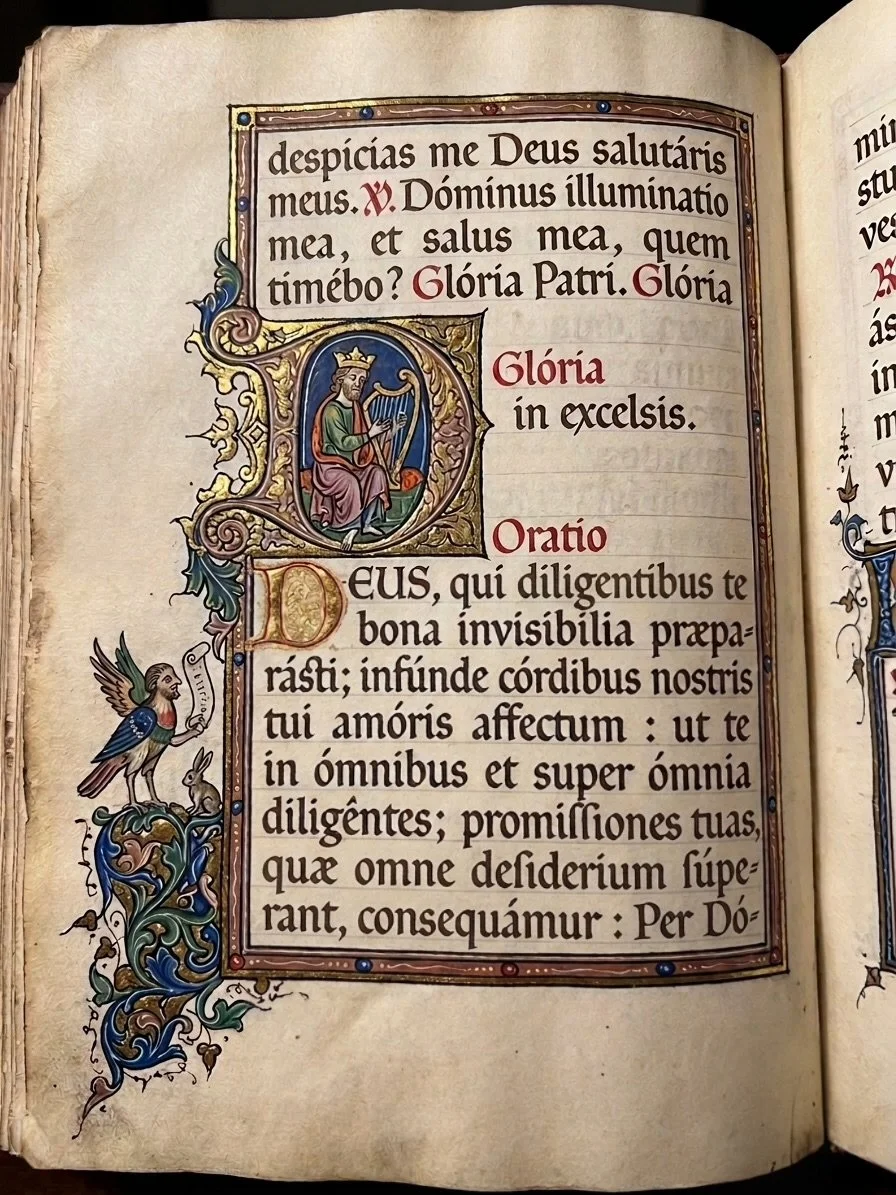
The Sarum Missal collect for the Sixth Sunday after Trinity.
Loving thee above all things.
Loving thee in all things.
Loving thee in all things and above all things.
Three versions of one phrase, from one prayer—the collect we prayed this evening. And the story of how we got from one to another is worth telling, because hidden inside it is one of the deepest questions we can ask about God.
Let me start with editing. We forget how rare a thing editing has been in human history. For most of the centuries of the written word, texts were copied, not edited—monks in scriptoria reproducing what lay before them, letter by letter, because the text was received, inherited, not theirs to touch. Very few human beings in history have sat down with an inherited text and deliberately changed it.
Thomas Cranmer was one of those few. He was a compulsive editor—and more than an editor, a translator. Father Devereux, in his study of the collects of the first Book of Common Prayer as works of translation, counted that of the hundred and one or so prayers Cranmer put into the Prayer Book, sixty-six were simply taken from the older Latin service books and translated. So the interesting thing is not that he translated, but how—because his translations are not always word for word. And he never explains his choices. We have to guess.
Here is what he did with our collect. The medieval Latin, prayed in this land for eight hundred years before him, asked that we might love God in omnibus et super omnia—in all things and above all things. Cranmer took that double phrase and rendered it simply: in all things. He dropped “above all things.” Devereux calls it a surprising choice—probably down to nothing more than a preference for simplicity.
Then, in 1662, the Caroline revisers did something stranger still. They swapped it round. Out went “in all things”; in came “above all things”—the version we now pray.
So notice what happened. At the Reformation, as the printing press made editing possible in a way it had never been before, this prayer got mucked about with. And whichever version you choose—the Cranmerian or the Caroline—you get a depleted prayer. Half the phrase. Half the thought. It took until the twentieth century for the 1928 Prayer Book to go back to the medieval original and restore the whole thing: in all things and above all things.
But what does the whole thing mean? This is where we must slow down and get it right.
How is God in all things? Quite simply as the epistle to the Colossians explains: all things were created through him and for him, and in him all things hold together. Everything that is created carries some trace of its creator. Augustine saw in creation the vestigia trinitatis - the ‘footprints’ of the Trinity. Maximus the Confessor saw in every atom of creation a little logos, a small word of God, made to reflect the one true and eternal Logos, the Word of God himself. But you can put it more simply than that. Everything that exists shares at least this much with God: that it is. Its sheer existence reflects the fact that God is. If it is a living thing, it reflects the fact that God is living, and shares that with him. If it is a thinking thing, it reflects the fact that God has mind. And so on, up the whole scale of being. In that sense - a real sense - God is in all things.
Then why do we say God is above all things? Because God is outside the created order altogether. He is not part of creation the way you and I are part of creation. He is outside time. He is not affected or diminished or changed by the things he has made. He is above all things because he is primordial—ontologically other. And here we must be careful, because “above” can mislead us. God is not above all things the way an emperor sits above his subjects—top dog at the apex of a pyramid, first in a hierarchy of things. He is above all things because he is outside the category of worldly hierarchies altogether. My ways are not your ways, saith the Lord; my thoughts are not your thoughts.
But how can both be true at once? In all things and above all things?
They can both be true because God's relationship with creation is not a competitive one. He does not have to withdraw for creation to exist, nor does creation crowd him out. And here is a picture that may help. Think of light coming through stained glass—the great rose window of Chartres. The light is, in a real sense, in the glass. It is only because light is in it and coming through it that you see anything at all: the blues, the reds, the fire of the colours. Take the light away and you would see nothing—dead grey, black. And yet the light is not possessed by the glass. It does not belong to it. It comes from outside, from a source far beyond the building. In the glass; above the glass. That is a little like God: genuinely present in all that he has made, making it shine, and at the same time utterly beyond it.
And this evening's Gospel gives us the same truth in miniature. The kingdom of heaven is like a grain of mustard seed: what could be more hidden, more ordinary, more in the world than a seed in the soil? God works quietly from within—in the dark, in the dirt, in the slow patience of growth. And yet what grows is beyond anything the seed could promise; no one looking at a mustard seed could guess the tree. In the field, and beyond all reckoning. In all things, and above all things.
The medieval prayer held those two truths together in a single breath, and would not let either go. For a few centuries we prayed the halves separately. Now we have the whole again. So let us pray it as it was meant to be prayed:
O God, who hast prepared for them that love thee such good things as pass man's understanding: Pour into our hearts such love toward thee, that we, loving thee in all things and above all things, may obtain thy promises, which exceed all that we can desire; through Jesus Christ our Lord. Amen.