Praestet fides supplementum…
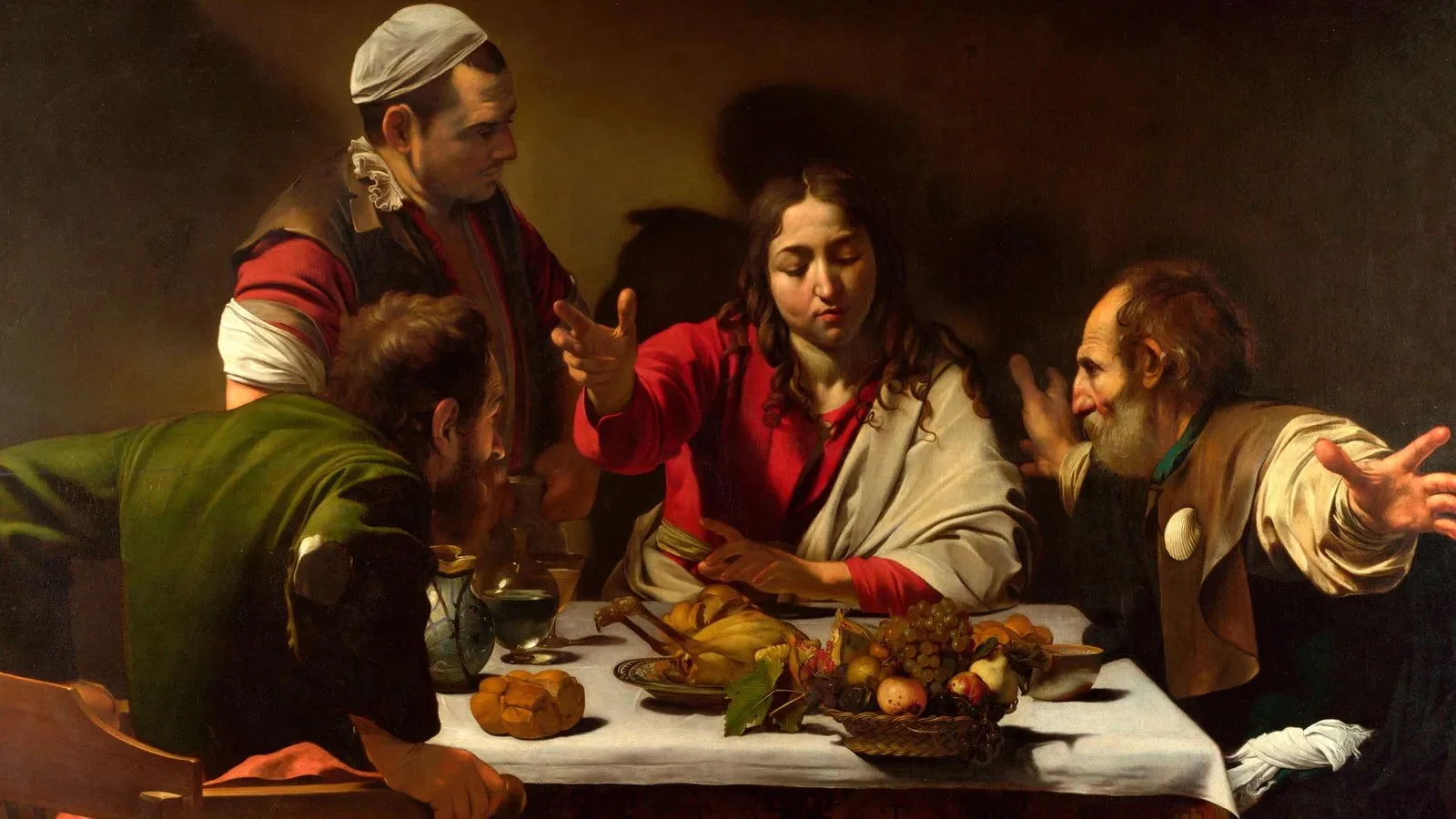
Caravaggio, Supper at Emmaus.
A sermon for Corpus Christi, 2026. Preached at St Paul’s, Knightbridge.
“I am the living bread that came down from heaven. Whoever eats of this bread will live for ever.” (John 6.51)
Now is about the time that going to art galleries in London can be hard as they pack out with tourists over summer. You go in there seeking contemplation, and what you get is a test in crowd-navigation - more Dunkirk that Dürer, more Agincourt than Antonello, more Trafalgar than Tintoretto. And now I’ve run out of artists to rhyme with battlefields. But there is a painting which you really should see in the National Gallery if you haven’t already— tourist or no tourist. The Supper at Emmaus by Caravaggio. It is the drama of Caravaggio applied to the Gospel story of Emmaus. Everything happens at once. Four figures. Two disciples at a roadside inn, a stranger sitting with them, bread on the table, and an innkeeper. The stranger reaches to bless the bread. And in that gesture, in that fraction of a second, the disciples know him. They recognise something he had done before. One grips the arms of his chair as if the world has lurched. The other’s arms fly open in something that looks almost like a fall. And the innkeeper stands behind them, seeing nothing unusual at all.
What arrests you, if you stay, is not the drama of the disciples’ gestures, though those are remarkable enough. What arrests you is the innkeeper. He stands slightly behind and to the left, looking on, present at everything, comprehending nothing. He is seeing what is in front of him. But he is also not seeing it.
It would be easy to make him a figure of incomprehension. That is not quite what Caravaggio is doing. The innkeeper is not inattentive. He is not stupid. He is looking at exactly what the disciples are looking at. The same loaf. The same hands. The same table. And he sees — bread. Which is precisely what his eyes are telling him, and his eyes are not lying to him. But something has happened in the breaking of the bread that the innkeeper has no means of perceiving, because the organ required for that perception is not the eye.
The question the painting quietly poses, to anyone who stays long enough, is what kind of perception we have. And it’s also the question posed by this feast, and this particular mystery of the Eucharist, on the feast of Corpus Christi.
St Thomas Aquinas, who wrote more precisely about this feast than almost anyone before or since, composed, in 1274, while in residence in Orvieto, a formulation that is as elegant as it is simple: it’s a kind of prayer, and it was turned into a hymn we sing here every year, all these centuries later, on Maundy Thursday: praestet fides supplementum sensuum defectui. Let faith supply where the senses fail. The word fail here – is worth pausing on. It does not mean that the senses are wrong, or deceived, or that what they report is false. It means more insufficiency — a falling short. The senses are doing their work faithfully. The reality that has become present is simply beyond their range.
John’s sixth chapter, which was our Gospel today, is, among other things, an extended meditation on what it means for a reality to exceed its own appearance.
By chapter six, Jesus has fed five thousand on a hillside. The crowd follows him back across the water; they want more bread. He tells them they are reaching for the right thing but not far enough. And then the claim the whole discourse has been building toward: “I am the living bread that came down from heaven.”
The Anglo-Irish theologian Herbert McCabe reflected much on Jesus’s choice of bread and wine to be the mode of his presence in the Eucharist. It is not, he said, as if Jesus took something that had no meaning and gave it one. Bread and wine, he said, are already a kind of language. When human beings share a meal they are saying something: we belong to each other, we share one life, this table is where our friendship is real. Every meal is already a word. What the Eucharist does is take that human word — the word that bread and wine have always spoken — and deepen it into something only God can say. Our language, over these elements, becomes God’s Word, God’s self-communication. One table, one bread. But what is present at it now is more than fellowship, and is no longer ordinary bread. It is the source of fellowship, giving himself.
And McCabe would not let us rest there comfortably. Because the Word that God speaks here is spoken over a body broken and blood shed. Just before consecrating the bread and wine at every mass, the priest says the words “on the same night that he was betrayed”. This was the context of the first Eucharist. This feast of friendship is also, inseparably, the sacrifice of the cross. The love enacted at this altar is not love that cost nothing. Rather, it cost everything. It is the love that the world, in its fear and its violence, met with execution. To receive the Eucharist is to be drawn into it not as observers but as participants. To say, with the body as much as with the lips, that the love which went to the cross is the love we are trying, however partially, to inhabit.
In the Caravaggio, the innkeeper sees bread. The disciples see the Lord. They are not imagining things. They are not projecting meaning onto an ordinary object. They are perceiving, by the grace of faith, what is actually there.
Corpus Christi is the feast on which we ask to always have those eyes — or, if we perhaps find that hard at times, to at least want them. The Archbishop of Canterbury, Michael Ramsey, said that we all should love God, but if you didn’t feel you did love God, but want to, don’t worry: because wanting to love God is very close to actually loving God. And it is the same thing, I think for Corpus Christi. To want to believe that Jesus is on the altar at Mass is very close to actually believing that he is. Which of course, he is, whether our minds can grasp that or not. So let us come to this altar not merely as people who appreciate the beauty of this service, or its antiquity, but as people who believe that in and though it something is here. Or rather that Someone is here. That when we eat this living bread we are taken into a life not our own, and held there.
Praestet fides supplementum sensuum defectui.
Let faith supply where our senses fail.