From data to person: ‘Magnifica Humanitas’ and the Trinity
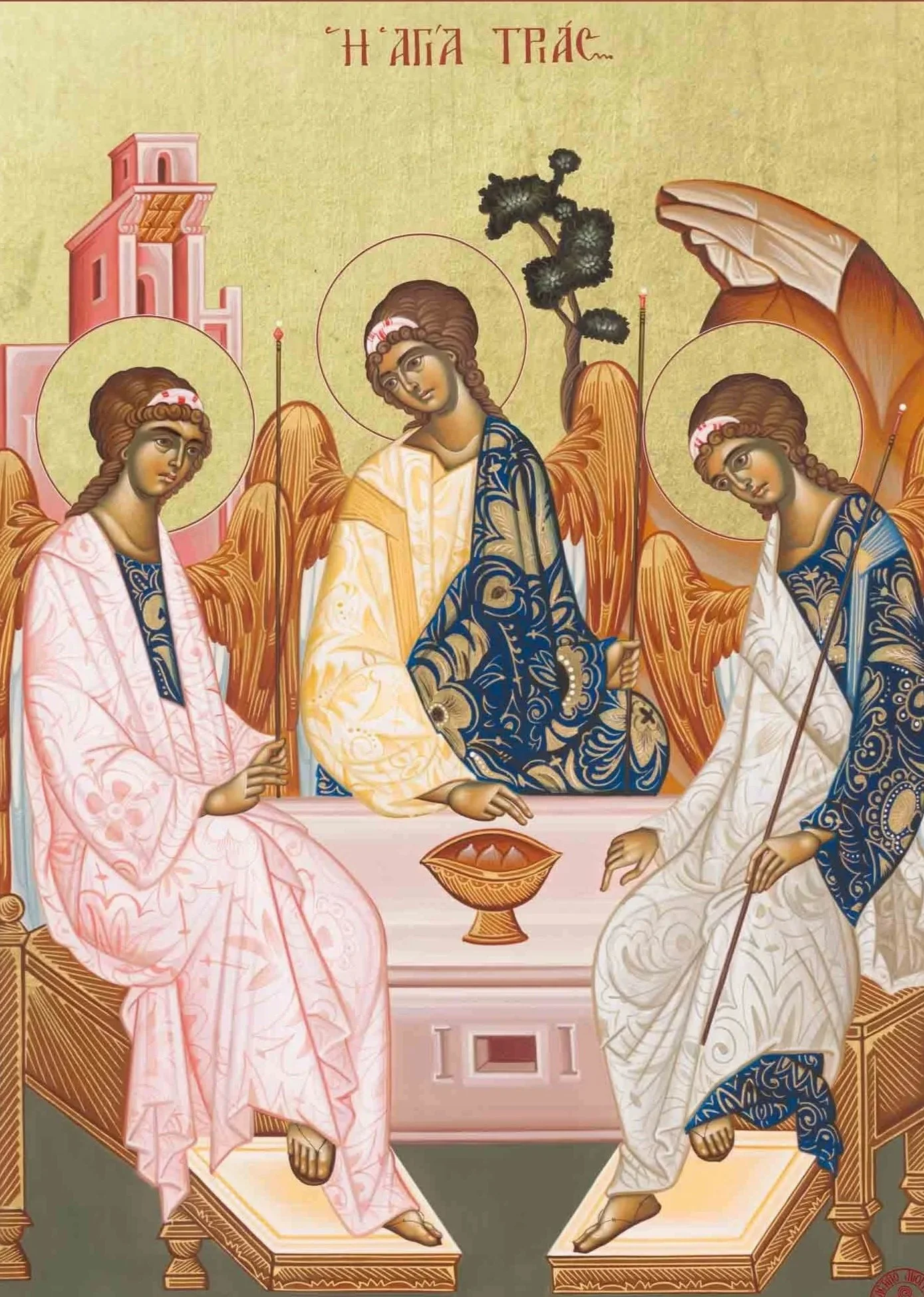
A sermon preached at Magdalen College, Oxford, on Trinity Sunday, 2026
If I wanted to know about you, I could, in the world we now inhabit, find out a considerable amount without ever meeting you. Your purchasing patterns. Your search history. Your location at various points during the day. The algorithm would build what it calls a profile — and in certain narrow senses, that profile might be accurate. It might even predict your behaviour with unsettling reliability.
And yet it would not know you. It would know about you, which is an entirely different thing. It would have data, but it would not have grasped the person.
The distinction is not merely sentimental. It goes, I want to suggest this morning, far deeper — down to the question of what kind of God we worship, who we are and who God is. And that is the question at the heart of Trinity Sunday.
The Hebrews had a certain amount of data about God. God is Creator, God is one. God is eternal. And so on. Those are descriptors, and important ones. But in the life of Jesus, the disciples were given something much deeper still: a revelation not of what God is, but who God is. And it was an astonishing one, even to the disciples: God is Father, Son and Spirit. God, in God’s innermost life, is a communion of three. Revealing the Trinity was a step in the disciples going from data about God to knowing who he is.
This week the world of theology has been particularly interested in questions of data. On Monday, Pope Leo XIV published his first encyclical, Magnifica Humanitas, on the subject of artificial intelligence in its relation to human beings. It has generated considerable discussion both in the spheres of Christian theology but also much more widely. Most of it has focused, reasonably enough, on Leo’s insightful treatment of artificial intelligence — on algorithms and data and the accelerating power of machines to process human beings at scale. But, reading it as I am at the moment, it strikes me that the most important thing about the document is not its diagnosis of technology. It is what that diagnosis rests on. Underpinning the encyclical is a Trinitarian understanding of God - and by derivation, of us his creatures who bear his image - which enables Leo to diagnose both the promise and the risks of AI.
Leo was formed in the Augustinian order, dedicated to the teachings of St Augustine. That is relevant too, because in the early church few were more devoted than Augustine to seeking to expound and inhabit what it means to say God is One in Three. We have the biblical revelation – Jesus invites the disciples to baptise into the name of Father, Son and Holy Spirit – and those names remain normative for us. But for those used to a more relational vocabulary Augustine in the De Trinitate[1] ventures the following. God as Trinity is Amans, Quod amatur and Amor. The Lover – the Beloved – and the Love they share, a love so real, so alive, so completely a presence between the Lover and the Beloved, that it is itself a person in the communion of three.
What this means — and this is the quietly astonishing claim of today’s feast — is that God has never been alone. Has never been without love, without relation, without the joy of the other. Before any universe existed, there was already this: gift freely given, and freely received, and the bond between the giver and the receiver: alive, personal, real. The Trinity is not a mathematical puzzle to be solved before we can get on with the Gospel. It is the revelation that at the very foundation of everything that exists, there is not a cold omnipotence but an eternal, overflowing communion.
We begin each Mass with “In the name of the Father and of the Son and of the Holy Spirit”. But imagine if just for one day, the church used Augustine’s words instead: “In the name of the Lover and the Beloved, and the Love they share”. Would that bring home to us how revolutionary our idea of God as Trinity is? And how it could – if reflected upon – change us, change the world. I think it could.
And that revolutionary understanding is at the heart of Magnifica Humanitas. Leo’s claim is this: that the reason we cannot reduce human beings to data is that humans are not information to be processed, as the algorithm might suggest, but persons, persons who bear the image of God. a relational, self-giving God. One who knows not just data but the person.
And God knows his creation too, not as data, but as beloved — known, and known with delight, by the one who is himself the eternal act of knowing and loving. When God knows you, he does not merely access your file. He calls you by name.
This is why the Pope's diagnosis of what he calls the Babel syndrome carries the weight it does. The replacement of persons by data — the reduction of a human face to a set of analysable patterns by a piece of code — is not, at its deepest level, merely an ethical problem, though it is certainly that. It is a theological one. To encounter a person without seeing them as beloved is to look at the image and miss entirely the one whose image it is. To entrust a human being to an impersonal data processor is to commit, quietly and at scale, a kind of iconoclasm. It risks operating to the whims of the minority of the powerful who own and can control AI, and can dehumanise and divide.
For the Christian, structures of artificial intelligence can work much good if they work towards genuine human communion – towards sharing knowledge, networks, resources into fostering the flourishing of the common good, the whole human race and its individual parts. That hope is the one which Leo seeks to set his seal to.
The core of that vision is the one revealed to the disciples on that Galilean hillside. Go. Make disciples. Go, and tell a world that is starting to know everything about people but understand less and less about persons — go and tell that at the heart of reality there is not a processor but a lover. Not a system but a name.
For those of us here who are baptised, we were given that name in baptism before we fully understood it.
Most of us are still finding out what it means to live inside it.
And that ongoing discovery — of being known, not as data, but as beloved, by a God who is himself the eternal act of loving — is, in the end, not a small thing.
It is the only thing.
In the name of the Lover and the Loved One and the Love they share. Amen.
[1] Ch VIII, 10.